Discover the Gas Laws with AI-Assisted Simulations
Boyle, Charles, Gay-Lussac, and Avogadro in one box of molecules, run by an AI agent.
The gas laws are among the first quantitative relationships a chemistry student meets: squeeze a gas and its volume drops, heat it and it expands, seal it and the pressure climbs as it warms. They are usually presented as formulas to memorize or as a cookbook laboratory exercise with a syringe and a hot-water bath. With AIMS, students discover these laws instead. They talk to an AI agent that builds and runs a real molecular dynamics simulation for them: they ask a question in plain language, and the agent sizes a box of molecules, conducts the experiment, plots the measured data, and helps them make sense of it. Nothing about the laws is programmed in — they emerge from the motion of individual molecules and the forces between them. In the window below, a box of hydrogen molecules is capped by a movable piston. Press Play and watch the molecules fly, collide with the walls, and hold the piston up against the load pressing down on it. Each atom is colored by its kinetic energy — red for fast, blue for slow — so students can watch energy pass from molecule to molecule as they collide.
A Piston Driven by Molecular Collisions
Every gas law relates two of four quantities — pressure, volume, temperature, and amount — while the other two are held fixed. To study them we need a way to hold two quantities constant while varying a third. AIMS does this with a movable-piston barostat: a weighted plate that seals the top of the container. A constant load pushes the plate down into the gas, while the gas molecules push it back up through a steady stream of collisions. Where the two balance, the gas pressure equals the applied pressure — a real constant-pressure ensemble that comes straight from the kinetic theory of gases, not from any hard-coded rule. A red arrow on the plate shows the applied load and grows longer as the pressure is raised, so students can see "push harder" before the plate has finished responding.
Because the pressure is a load the molecules must hold up by striking the plate, and the volume is read from the height at which the piston floats, the simulation gives students a microscopic picture of what pressure and volume actually are. A gas law that a textbook states in one line becomes something students can watch happen, molecule by molecule. And they never have to build any of this through menus and dials: they describe what they want in plain words, and the AI agent sizes the container, places the gas, switches on the piston, sets its load, and drives it — the whole apparatus is assembled from a few sentences.
Ask a Question, Run an Experiment
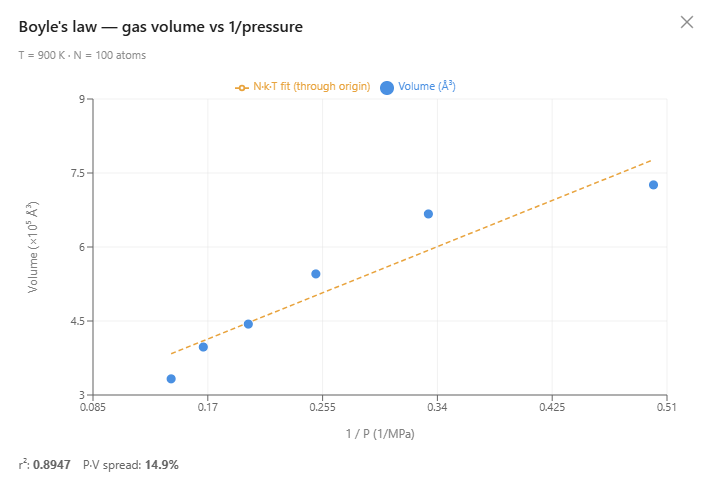
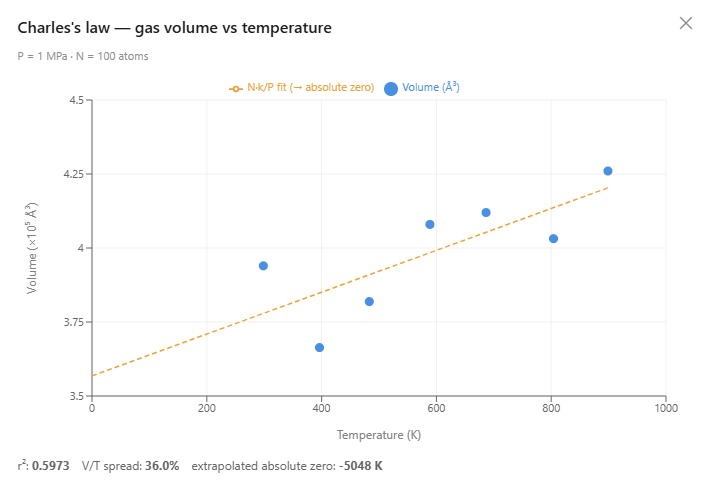
AIMS is an AI-native environment, and the gas-law investigations are a clear example of what that means. A student does not need to know the name "Boyle's law" or how to configure a barostat sweep. They simply type an everyday question into the chat — "what happens to the volume if I squeeze the gas?" — and the built-in AI agent recognizes the intent, steps the piston pressure through a series of values, waits for the gas to re-equilibrate at each, measures the volume, and drops a live chart of the results straight into the conversation. The experiment a student would otherwise have to build by hand is set up and run for them, and the measured data — not a canned illustration — is what they see.
You can build and run the whole investigation from scratch. Start a new Molecular Modeling project, open the chat, and type these prompts in order. The first group prepares the simulation — sizing the container, adding the gas, setting the conditions, and switching on the piston — so you have a working, watchable gas. The second group then runs the four experiments, each returning a chart in the chat.
Prepare the simulation
- Size the container — "Resize the simulation box to 80 × 80 × 120 ångströms so the gas has room to expand and the piston can travel."
- Add the gas — "Add hydrogen to the gallery, then scatter 50 hydrogen molecules across the box."
- Set the conditions — "Hold the temperature at 300 K and use a 1 fs time step, since the H–H bond vibrates quickly."
- Switch on the piston — "Turn on the piston at 2 MPa with a light 20 amu plate so I can see it move."
- Run it — "Run the simulation for 10 picoseconds so I can watch the gas hold the piston up, then stop."
Investigate the four gas laws
- Boyle's law (volume vs. pressure) — "What happens to the volume if I squeeze the gas?"
- Charles's law (volume vs. temperature) — "What happens to the volume when I heat the gas?"
- Gay-Lussac's law (pressure vs. temperature) — "In a sealed, rigid container, what happens to the pressure as the gas gets hotter?"
- Avogadro's law (volume vs. amount) — "If I add more gas at the same temperature and pressure, what happens to the volume and the density?"
Each sweep reuses the piston and thermostat you set up (Gay-Lussac temporarily switches the piston off for its constant-volume run) and restores your simulation afterward, so you can keep exploring between experiments.
Each investigation is a sweep: a sequence of small experiments in which one control variable is stepped and one observable is measured. The results accumulate into a single interactive chart embedded in the chat log — a lab notebook that records what was actually measured at that moment. The four classic gas laws map onto four sweeps.
The Four Gas Laws
Boyle's law (constant temperature). Holding the temperature fixed, the agent raises the piston pressure step by step and measures the shrinking volume. Plotted as volume against the reciprocal of pressure, the points fall on a straight line through the origin: the product P·V is constant. Double the pressure and the volume halves. Push the pressure much higher and a dense gas begins to depart from the ideal law, which is itself a teachable moment rather than an error.
Charles's law (constant pressure). With the piston holding the pressure fixed, the agent steps the temperature and measures the expanding volume. Volume rises in direct proportion to the absolute temperature, giving a straight line that, extended backward, heads toward zero volume near −273 °C — the classic extrapolation toward absolute zero, here extended from the measured data.
Gay-Lussac's law (constant volume). This one is mechanically different: the piston is switched off and the container becomes a rigid, sealed box. Now volume is the constant and pressure is the measured quantity, computed from the molecules' motion and the forces between them. As the gas is heated, the pressure climbs in direct proportion to the absolute temperature. It is the same physics that makes a sealed can dangerous in a fire, and it too extrapolates to zero pressure at absolute zero.
Avogadro's law (constant temperature and pressure). Here the agent changes the amount of gas — the number of molecules — while holding temperature and pressure fixed, and measures the volume. Volume grows in direct proportion to the number of molecules: a straight line through the origin. This sweep also answers a subtler question that students often find confusing. Density is the mass divided by the volume, ρ = N·m / V. Because the volume grows in step with the number of molecules, the ratio N / V — and therefore the density — stays constant. Adding more gas at the same temperature and pressure makes the sample bigger but no denser, a fact that follows from V ∝ N and is easy to see once the V-versus-N line is on the screen.
Why Molecules Matter
The gas in these experiments does not have to be hydrogen, and the choice matters more than it first appears. In the ideal gas law — written P·V = nRT with n in moles, or equivalently P·V = NkT with N the number of molecules — the amount of gas is counted in molecules, not atoms; each molecule, whatever its internal makeup, strikes the walls and claims its share of the volume as a single particle. A monatomic gas hides this distinction, because its atoms are its molecules; but for hydrogen the two differ by a factor of two, and for larger molecules by more. That is exactly why it matters that AIMS can build genuine molecules, not just lone atoms of an inert gas: the gas laws are laws about molecules, and a box of 50 hydrogen molecules behaves as 50 particles, not 100.
Hydrogen is only the starting point. AIMS can build almost any molecule on request, so a student can swap it for nitrogen, oxygen, carbon dioxide, methane, water vapor, or a noble gas like helium or argon with a single sentence, then rerun the same sweeps. Comparing the results turns the choice of gas into an experiment of its own: small, weakly interacting molecules track the ideal-gas laws closely, while larger or more strongly attracting ones deviate sooner — a direct, measured look at where the ideal-gas picture holds and where it breaks down.
Why Use AI to Assist Scientific Simulations?
The value of doing this in a simulation is that nothing about the gas laws is assumed in advance. The molecules obey only Newton's laws and the forces between them; the pressure is either the load their impacts hold up or, in a sealed box, computed from their motion and forces; the volume comes from the piston height, and the temperature from the average kinetic energy. When a straight line appears on the chart, it is the outcome of the microscopic dynamics, not a curve drawn to match a formula. Students experience the gas laws as emergent consequences of kinetic theory — and probe the boundaries, such as how a gas departs from ideal behavior when it is squeezed hard enough. What the AI adds is access: the machinery that makes such an experiment possible — a barostat, a thermostat, a stepped pressure sweep, an equilibrium average — is exactly the machinery a beginner does not yet know how to operate, and the agent operates it for them.
And the investigation follows the student's curiosity rather than a fixed worksheet. Because the AI agent maps natural-language questions onto the right experiment, a student who wonders "does the pressure go up if I heat a sealed container?" or "does adding more gas change the density?" gets an experiment and a chart in reply, not just a sentence. The conversation becomes the laboratory notebook, and each question a new run.
Conclusion
This article uses the gas laws to illustrate a new way to learn science: students converse with an AI agent that turns a plain-language question into a real molecular dynamics experiment and hands back measured data. The four historical laws — Boyle, Charles, Gay-Lussac, and Avogadro — become patterns that students discover, measure, and explain from the motion of molecules. By pairing a physically grounded simulation with an AI that can set it up and run it, AIMS connects the microscopic and macroscopic pictures of matter and lowers the barrier between a student's curiosity and a genuine scientific investigation.
← Back to AIMS